At the end of the Submarine project I mentioned that August held “a different kind of running project involving trails, but that’s a story for another day”. Today is another day. Mid-August I trail-ran a section of the GR11 through the Aragonese Pyrenees: four days, 121 kilometres, 6,550 metres of climbing, from Canfranc to Torla-Ordesa, solo, with a 15-litre bike backpack.
The four stages at a glance — the complete tour can be found on Komoot.
Why the Pyrenees
After Submarine wrapped up a month ahead of schedule, the plan was to take a season break in August before the next block. But a break without moving didn’t sound right. I honestly can’t reconstruct where the idea came from exactly: somewhere between following Arda Saatci’s Cyborg Season in May, wanting to go to Spain anyway and the general itch to combine running with mountains. At some point I found La Senda, a blog covering the Pyrenees and its routes in depth, and read my way through it. I settled on the GR11, the long-distance trail crossing the Spanish Pyrenees from coast to coast.
Running the whole thing takes weeks, so I picked a section: joining the GR11 at Candanchú and following it to the Bujaruelo valley, with Canfranc Estación as the lead-in and a finale over Pico Taillón down to Torla-Ordesa. Four stages, each ending somewhere with a bed and food.
The (non-)plan
Compared to Submarine’s discipline, the planning here was refreshingly loose. I booked the middle nights barely one to two weeks ahead and winged the rest. In Sallent de Gállego and Torla I literally walked around town asking for a room. In Torla half the places were booked out, so I ended up paying a bit more than planned. Worked out anyway.
The gear had to fit into a very old 15-litre Deuter Race X bike backpack: one running outfit (washed daily in a river or sink), a second pair of socks, trail shoes on my feet, a quick-drying towel, headlamp, sunscreen, rain jacket, fleece, foot tape, a buff, earplugs for the refugios, a filter bottle, collapsible plastic water containers and some cash. No trail vest, no camping gear.
The one gear drama happened before the trail even started. The plan was to buy trekking poles at the Decathlon in Zaragoza the day before and return them after the trip. Except I arrived on August 15th, a Catholic holiday in Spain, and everything was closed. So I bought poles in Sallent de Gállego on day one and they were worth every cent. Offloading energy into the arms on all those metres of descent really saved my legs.
Navigation: GPX files on Komoot, downloaded offline, synced to my Garmin watch. That setup worked flawlessly. I drifted off track a few times but never had to properly turn around.
Day 1: the baguette
Canfranc Estación → Candanchú → Sallent de Gállego · 35 km · 1,600 m up · 6:35 moving
I left Canfranc at 6 a.m., way before anything opened, meaning: no breakfast, no supplies. No problem, I thought, I’ll buy something in Candanchú. Turns out Candanchú is a ski resort and in summer it’s a ghost town. The few restaurants that exist don’t open before 11 a.m. I also urgently needed a toilet. Eventually I spotted a lady cleaning up her bar and asked if I could use hers. She agreed, and on the way out I saw a stack of baguettes being delivered to her. So I asked if she’d sell me one. She did.
That baguette became my entire food supply for a 35-kilometre mountain day. I ran up and down the passes with a baguette in my hand until it was gone, which felt appropriately ironic for someone who had just spent five months on a precisely structured training plan.
Day 1 fuel: running the GR11, baguette in hand.
In Sallent de Gállego I hit the last proper supermarket before the end of the route and loaded up accordingly: a roughly 5,000-calorie haul of chocolate, empanadas, cheese, bakery cookies and peanuts, providing dinner, breakfast and snacks for the days ahead. I also got lucky and found a cheap, lovely room in a traditional bed and breakfast above a restaurant.
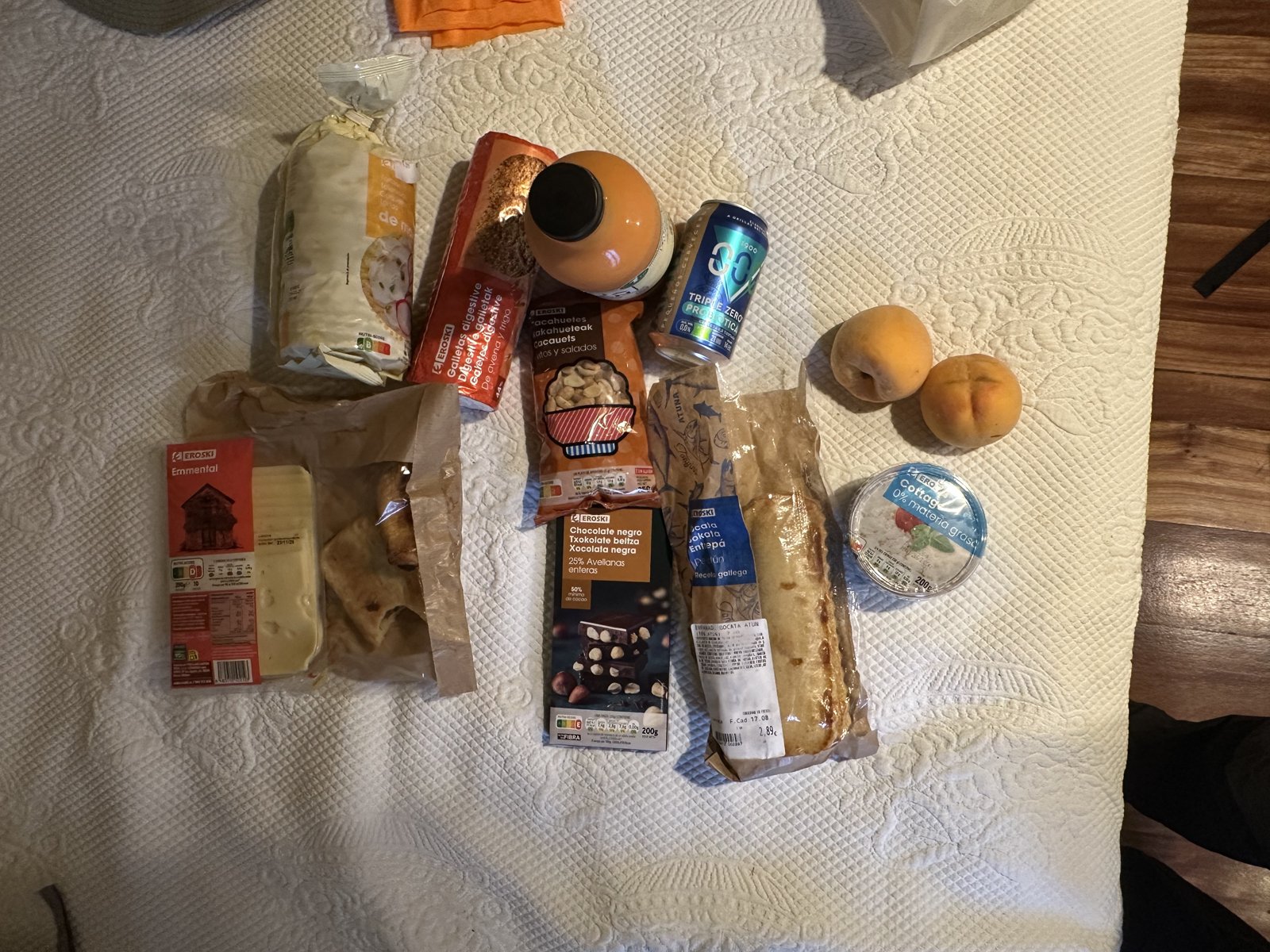
The 5,000-calorie haul from the last proper supermarket, Sallent de Gállego.
Day 2: the technical one
Sallent de Gállego → Refugio de Respomuso → Collado de Tebarray → Baños de Panticosa · 25 km · 1,750 m up · 6:00 moving
The signs out of Sallent said 3.5 hours to Refugio de Respomuso. I did it in 1.5, arriving early enough that the refugio hadn’t even opened, so I sat down and fueled up with my snacks instead. Road engine, meet mountains.
Then came the Collado de Tebarray, a high mountain pass and the steepest climb of the whole trip, the only one that turned into actual climbing. The descent on the other side was the most technical part of the route: an endless field of loose stones that took ages to get down.
Almost all the way down I met the only person on the entire trip who was as fast as me downhill, a hiker flying over the rocks. We ended up at the same dinner table the day after. More on him later.
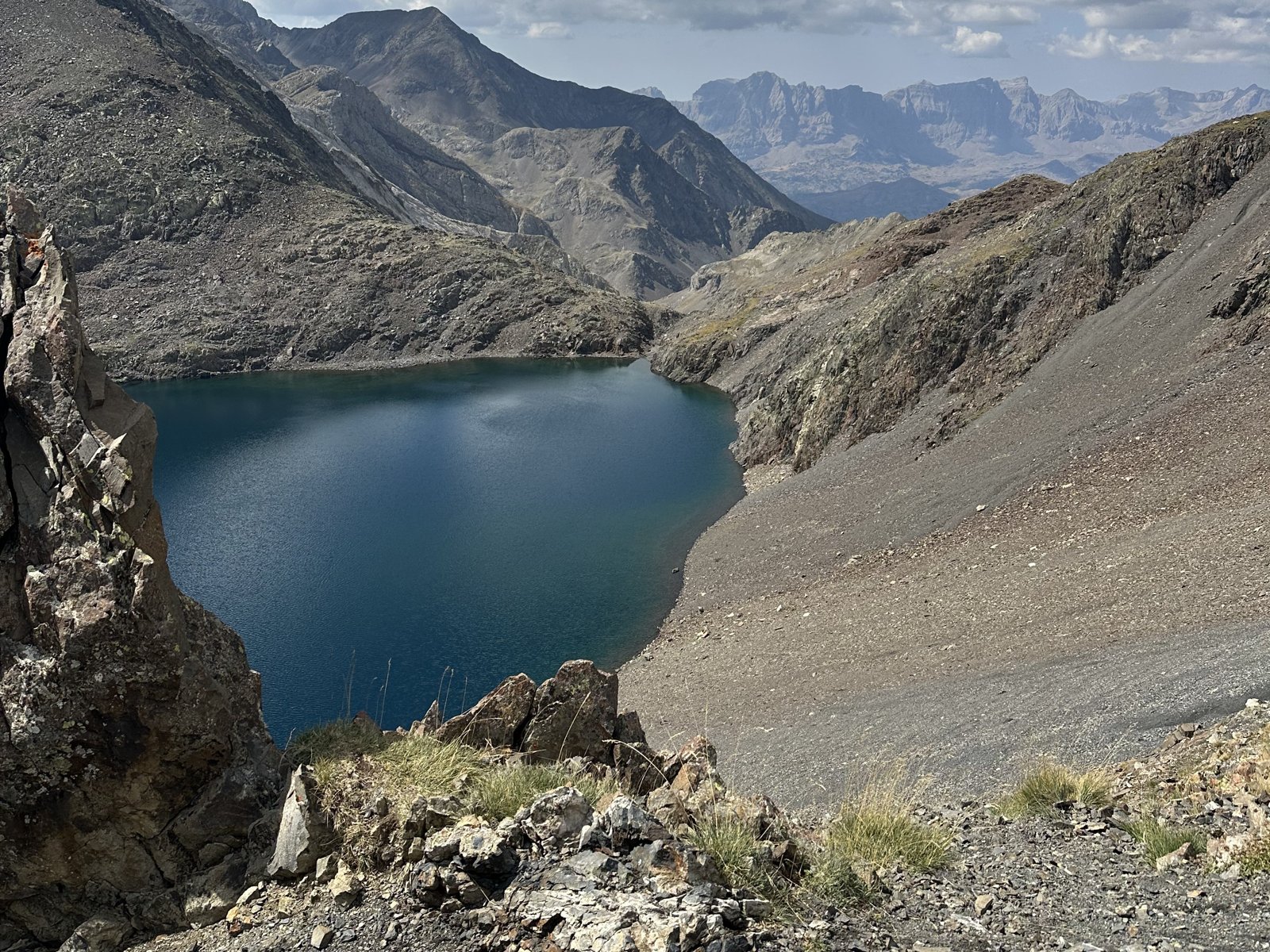
The ibón below the Collado de Tebarray, right before the hands-on part.
Day 3: the accidental taper
Baños de Panticosa → Collado de Brazato → San Nicolás de Bujaruelo · 21.2 km · 1,100 m up · 4:25 moving
Leaving Baños de Panticosa I walked the first stretch with a local hiker who knew the name of every mountain peak around us. At some point we heard a deep growl echoing through the mountains — rockfall somewhere, he reckoned. We heard it, never saw it.
After the Collado de Brazato came another annoying stone field, but then the day turned into a gift: six kilometres of perfectly runnable path down into the Ara valley to San Nicolás de Bujaruelo. I arrived at 12:30. The refugio’s reception opened at 15:30. So I spent three hours sleeping by the river, which — entirely unplanned — turned out to be the perfect taper for what came next.
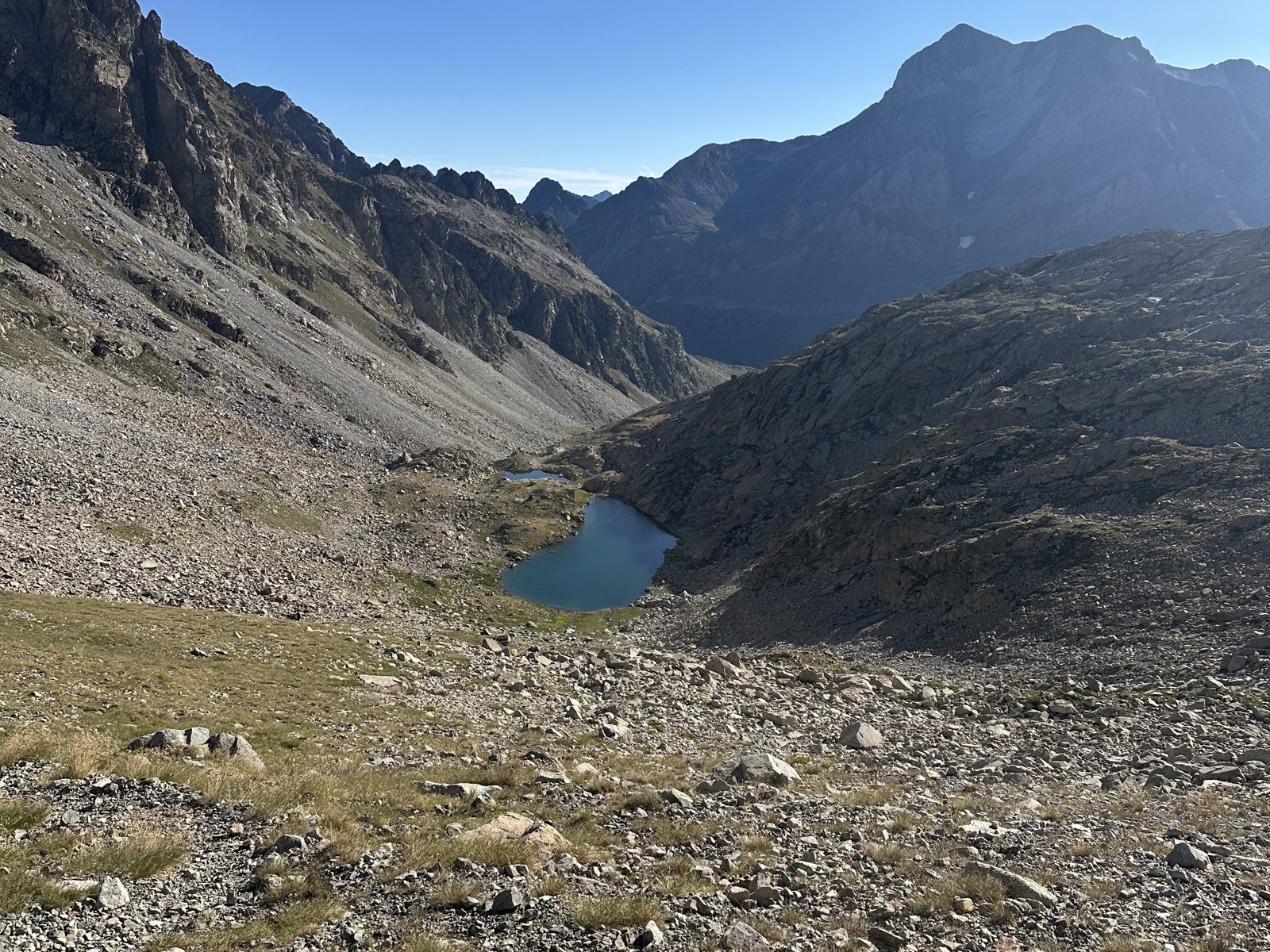
Six kilometres of runnable gift: the Ara valley down to Bujaruelo.
Day 4: the longest run of my life
San Nicolás de Bujaruelo → Pico Taillón → Refugio de Góriz → Torla-Ordesa · 40 km · 2,100 m up · 8:40 moving
Out of the refugio at 6 a.m., headlamp on. The fast hiker from day 2 had shown up in Bujaruelo the evening before and joined me for the morning climb. On the way up we spotted a group of wild boars (jabalíes in Spanish), which I’d never seen in the wild before. We split near the top and I never saw him again. Trail friendships have a short half-life.
At 10:30 I stood on Pico Taillón at over 3,000 metres, my first 3,000er ever. The way up had a surreal moment: after two days of near-solitude, the ridge below the summit was crowded with French day tourists, thanks to a parking lot on the other side of the border.
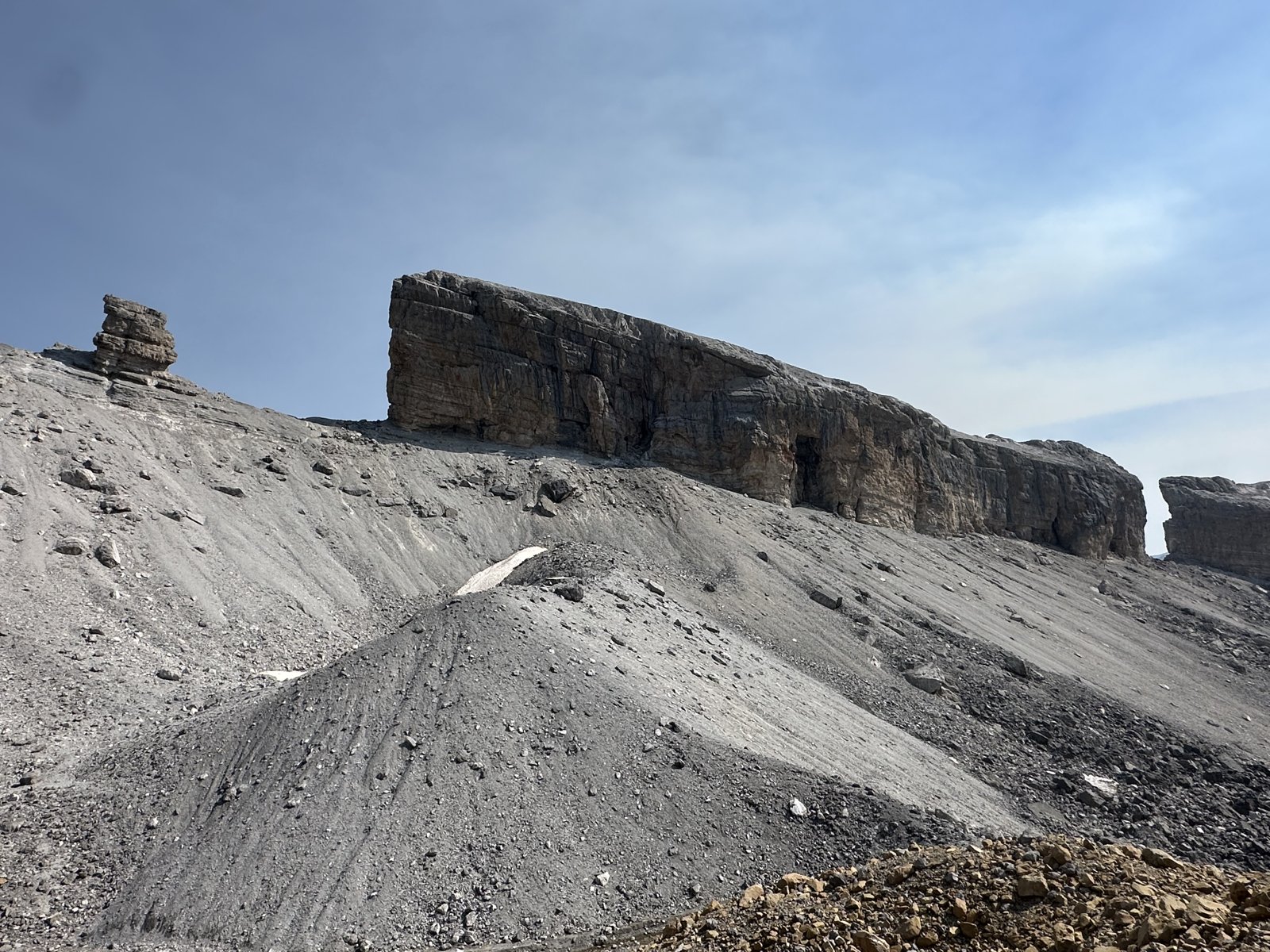
The view of the Brecha de Rolando, after climbing Pico Taillón, my first 3,000er.
From the Brecha de Rolando — a giant natural gap in the border ridge — the route dropped past Refugio de Góriz. Shortly before Góriz I met the only fellow trail runners on the entire trip. Fueled by a hiker’s cheese at the refugio, I had “only” downhill left. Except downhill meant another 20 kilometres through the Ordesa canyon. I ran most of it, and fast. When I rolled into Torla-Ordesa the watch read 40 kilometres — my longest run ever, roughly double the previous record, my 2024 half marathon. I hadn’t eaten much all day, so the first thing I did in Torla was buy a quarter of a watermelon and demolish it.
The break in numbers
Four days: 121 kilometres, 6,550 metres of climbing, about 25 hours and 40 minutes on my feet. For perspective: five months of Submarine produced 11,364 metres of climbing, so this break did more than half of that in four days.
Gear verdicts: the poles were the MVP. The 15-litre bike backpack fully replaced a trail vest. Never used: the rain jacket, the fleece (one of the two would have been enough), the filter bottle (clean water everywhere), the buff and the power bank (every stop had outlets and the watch battery held).
The storms I packed for did show up but reliably in the late afternoon, always two to three hours after I’d arrived. I’ll take the luck.
Some thoughts
The biggest takeaway: the engine transfers. Five months of road training meant the climbs felt strong and, surprisingly, I needed far less food than every guide suggests. A baguette here, some cookies there. My strategy became: run fast, arrive early, then rest and eat the entire afternoon. Fasting during the day in recent years definitely prepared my body for this, too.
The body held up too. In the first days it was the knees complaining, by the end it was the feet: swollen from wet shoes, a few blisters, nothing major.
And the mountains gave something back. Since returning, my heart rate at any given pace sits noticeably lower than in July. Some of that is August temperatures, but I credit a good part to days of continuous work at altitude. I went into this trip to take a break from the engine and came back with a bigger one.
Logistics footnote: getting home from Torla was a bus to Sabiñánigo, a bus to Zaragoza, onwards to Bilbao for the Aste Nagusia festival and from there home. The Pyrenees are beautifully inconvenient.
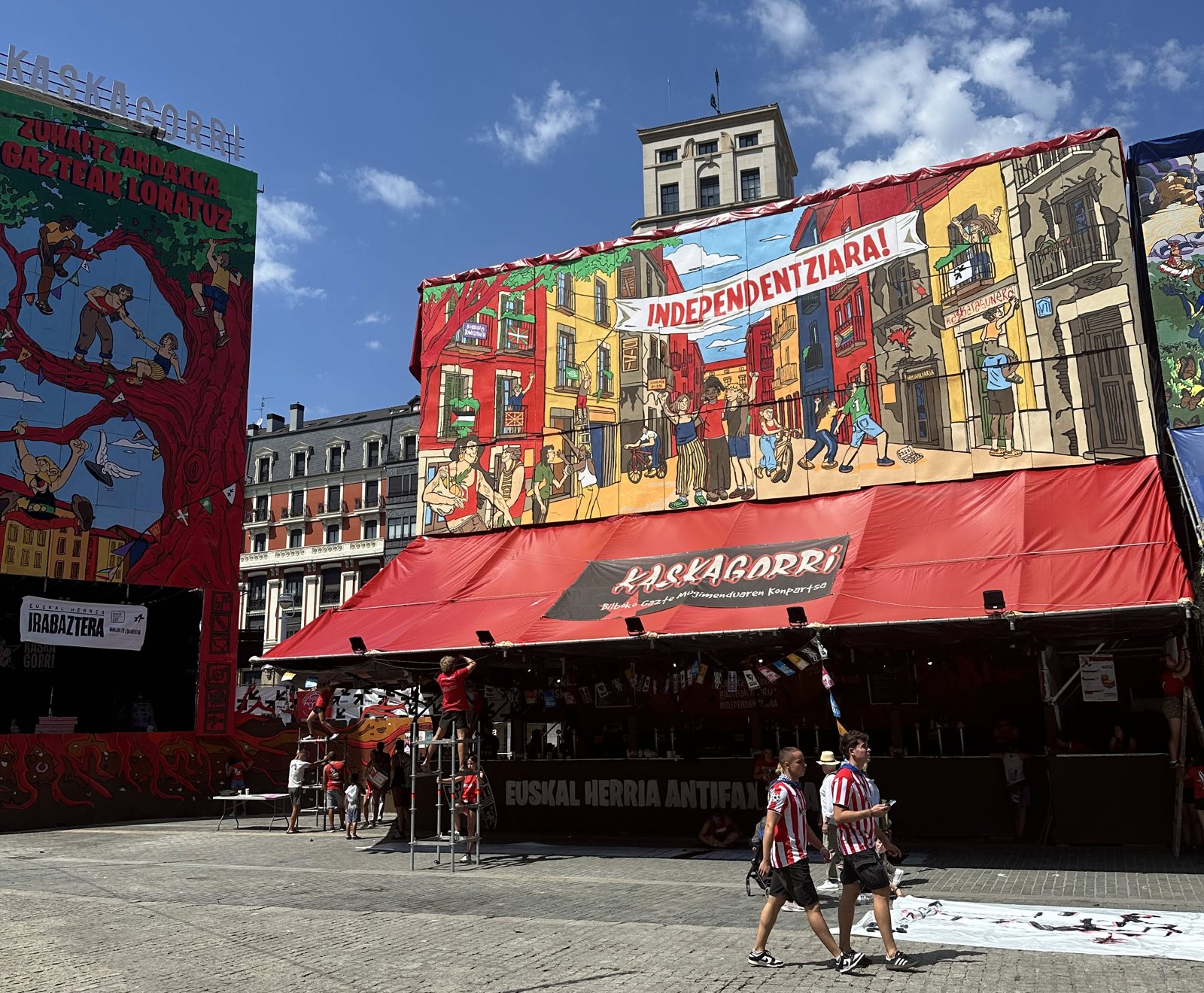
The reward stop: Aste Nagusia in Bilbao.
What’s next
The break is over. Project “Revenge” started in the last week of August: three races across Europe and the goal of a half marathon under 1 hour and 20 minutes. The engine is there, now it needs pace.